
The platform behind the grid of tomorrow.
Energy across the region is expensive, unreliable, and delivered by thousands of companies too small to change it. Andara is building the platform that will — acquiring proven local operators, financing the infrastructure, and selling energy as a service instead of equipment.
- 175 GW
- Solar capacity projected across Latin America by 2030 if regional targets are met — close to three times the 2022 level.
- 15%+
- Compound annual growth in regional solar through 2030 — the fastest-growing energy source in Latin America.
- 50%+
- Caribbean businesses that already run their own generator — paying for resilience the grid does not deliver.
- 5%
- Latin America's share of privately financed global clean energy investment. The capital has not arrived.
Sources: IEA, World Energy Investment 2025; IEA, Latin America Energy Outlook; World Bank Enterprise Surveys; projections based on the region's stated renewable targets. These are third-party market projections, not Andara forecasts.
An industry with thousands of players and no leader.
Across Latin America and the Caribbean, distributed energy is being built by hundreds of small, capable, founder-led companies. They have the licences, the crews, the customer trust and the local knowledge. What almost none of them have is capital, financing products, regional purchasing power, or the systems to manage assets over twenty years.
At the same time, demand is structural, not cyclical. Commercial and industrial users face high tariffs, unreliable grids, or both. They want lower, more predictable energy costs — and they do not want to spend their capital to get them.
The gap between what the customer needs and what the market can finance is the opening. Andara exists to close it.
Fragmented supply
Hundreds of operators. None with scale.
The market is served by founder-led firms operating in single cities or single countries. Fragmentation keeps procurement expensive and financing out of reach.
Structural demand
High tariffs. Fragile grids.
Commercial and industrial consumers pay some of the highest electricity prices in the hemisphere. Reliability, not sentiment, is what drives their decisions.
Missing capital
The technology is ready. The financing is not.
Hardware costs have fallen for a decade. What remains scarce is balance sheet capacity to own systems and contract energy over twenty years.
We don't buy panels. We buy capability.
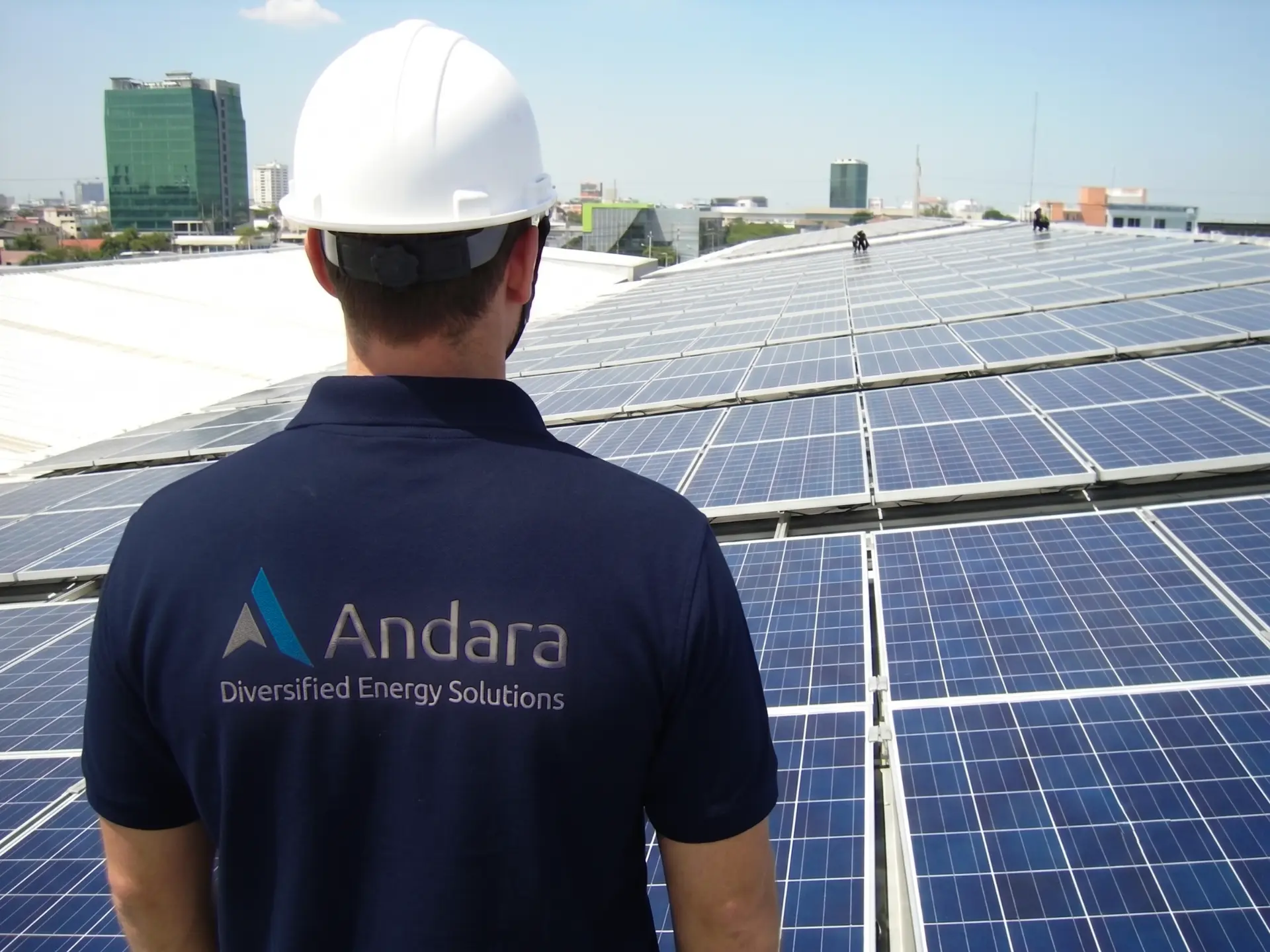
Equipment can be bought from a manufacturer. Trusted customer relationships, qualified technical teams, local licences and twenty years of reputation cannot. Those are the assets we acquire — and then back with institutional capital, centralised financing and shared operating systems.
- 01
Acquire
We acquire going concerns — companies with customers, contracts, crews and revenue. Founders retain a role and continuity is preserved, because the operating history is the asset. We do not build businesses from zero in markets we do not yet understand.
- 02
Integrate & scale
Procurement, financing, engineering standards, technology and asset management are centralised at the platform level. Each company keeps the brand, the team and the local relationships that make it work. What changes is cost of equipment, cost of capital and the quality of the systems behind it.
- 03
Own the infrastructure
We shift from selling installations to financing and owning the infrastructure under long-term contracts. Revenue becomes recurring and contracted rather than project-by-project, and the asset base compounds with every deployment.
Five services. One relationship.
Andara is technology-neutral. The objective is not to sell solar panels — it is to design, finance and operate the right energy infrastructure for each customer, and keep it running for decades.
Not sure what you need?
Most customers don't need a technology. They need an outcome — cheaper, more reliable energy with no surprises. We design the combination.
Talk to usReliable energy. Lower costs. No large upfront investment.
The obstacle was never the technology. It was the cheque. Under Andara's subscription model, we finance, install, own and operate the system. You pay for the energy and availability you receive, month by month, under a long-term agreement.
The traditional route
Buy the equipment yourself
- —Significant upfront capital outlay
- —Energy assets sit on your balance sheet
- —Performance and technology risk is yours
- —Maintenance, monitoring and replacement are your problem
- —Savings depend on your team getting the design right
- —Competes with capital you would rather invest in your business
The Andara model
Subscribe to the energy, not the equipment
- Zero upfront investment
- Andara finances, owns and operates the system
- Equipment and performance risk sits with Andara
- 24/7 monitoring and predictive maintenance included
- Predictable monthly cost, contracted for the long term
- Your capital stays in your business
Contract structures vary by market, consumption profile and regulatory framework. Andara designs the appropriate commercial structure for each customer.
Each step makes the next one easier.
Acquisitions, integration and infrastructure investment are not separate initiatives. They feed each other. Every company acquired widens the customer base; every asset financed widens contracted cash flow; every dollar of contracted cash flow widens the capacity to finance the next acquisition.
- 01
Acquire local energy companies
Each acquisition brings an installed customer base, a licensed operating platform and a technical team. Scale arrives on day one rather than after years of organic build-out.
- 02
Centralise procurement, financing and technology
Volume purchasing lowers equipment cost across every company in the platform. One financing structure and one technology stack replace many improvised ones.
- 03
Improve margins and operating capability
Lower input costs and shared engineering standards raise margin per project. Better systems raise the quality and speed of delivery.
- 04
Offer customers financed solutions
With capital behind it, the platform can quote a monthly energy cost instead of a capital expense. The addressable market widens to every customer who could not write the cheque.
- 05
Deploy and own more infrastructure
Financed projects stay on Andara's balance sheet under long-term contracts. Each deployment adds a contracted, inflation-aware revenue stream.
- 06
Recycle recurring cash flow
Contracted cash flow supports the next round of acquisitions and the next tranche of infrastructure. The cycle then repeats in every market the platform enters.
Start where the model works. Then repeat it.
Fifteen markets across Latin America and the Caribbean were screened against six factors: electricity prices, grid reliability, the regulatory framework for third-party energy billing, the foreign investment climate, local market fragmentation, and addressable market size.
High tariffs, workable third-party billing rules and a fragmented operator base make these the first platforms.
Strong demand fundamentals with regulatory or scale questions still being tested before commitment.
Large addressable markets that require established platform capability before entry is justified.
Market sequencing per internal research as of August 2026, verified against national regulators, the World Bank, the IDB, the IEA and IRENA. Sequencing is subject to change as regulatory and market conditions evolve.
The region's energy transition will be built by platforms, not by thousands of disconnected installers.
Andara is building that platform — acquiring the best operators in each market, giving them institutional-grade capital and systems, and converting the business of selling equipment into the business of owning infrastructure.